

Estimated reading time: 5min
Star Wars works! I got feedback via my “It’s Dangerous To Go Solo” blog post, that – maybe unsurprisingly – often was related to Han Solo. And I consider this a good sign. And you may have guessed by now that I enjoy going to the movies, so I want to keep up the Star Wars momentum and quote another great leader from the franchise:
“I am not a committee!” — Princess Leia in The Empire Strikes Back
In the movie Princess Leia answers to Han Solo, one can hear the outrage in her voice, and they both refer to the primary legislative body of the Galactic Republic: The Senate. Obviously in a derogatory way, because the committees are famous across the galaxy for delaying things and not getting anything done. Which unfortunately is also a misconception about Communities I sometimes come across.
And don’t get me wrong: There is the real danger of a Community of Practice becoming a committee or, to stay in the picture, to turn to the dark side. But to prevent this from happening it helped me a lot to better understand what a Community of Practice actually is. And the misconceptions often start with the definition. It is easy to find definitions that somehow sound like this: “Communities of Practice are organized groups of people with a common interest in a specific technical or business domain.”. This is not wrong. But it is also not complete. The idea of a Community is to combine domain knowledge with a community and with practice! The definition above is incomplete because it misses out on the “practice” part. What Etienne Wenger has to say about communities was very helpful for me. He gives some more details on what a community should be:
“Communities of Practice are groups of people who share a concern or passion for something they do and learn how to do it better as they interact regularly.” (see visualization below)
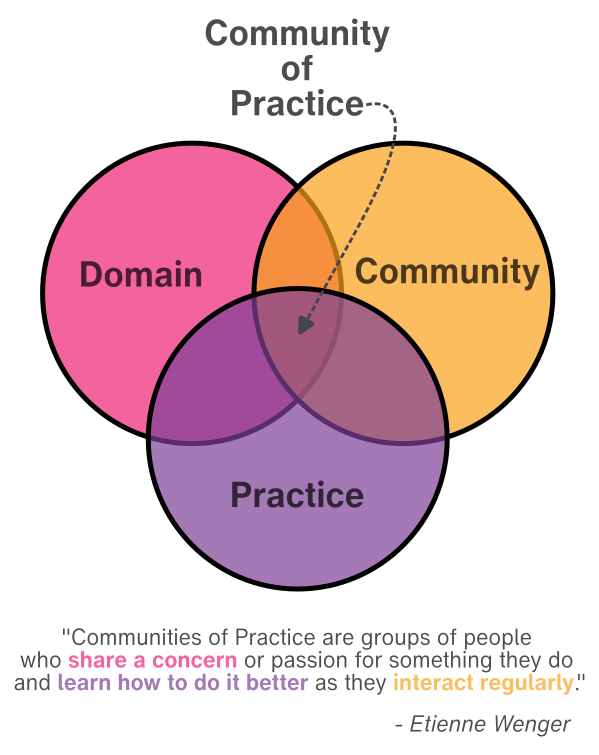
The definition by Wenger can be broken down as depicted in the attached visualization, where “share a concern” refers to the domain of the community and what is usually discussed. The “interact regularly” part is the community aspect, sharing time and space together to actually exchange on the topic. And “learn how to do it better” is the practice aspect and unfortunately sometimes underestimated or even forgotten. We meet in Communities because we find value in the interactions. We help each other to solve problems. And the concept of a community is not new, in fact it is one of the first knowledge-based social structures we know (when we lived in caves and gathered around the fire to discuss which roots are edible). But they seem still somewhat new in the work context. So it is rather the need of the organization to manage knowledge that drives the need for Communities of Practice.
And the domain & community part usually is not what paves the way to the dark side. It is the practice part. Actively practicing what we are talking about is what prevents us from going to the dark side. Useful knowledge is not something that can be managed like other assets in a work context, it is not a self-contained entity. Nor is it “free floating” in books or the internet. It must be put to use. Maybe an example can help: Imagine a friend has read many books about brain surgery and offers you to operate on your brain. You would be right to politely decline the offer. But with this in mind, another aspect of the Community of Practice becomes obvious: Providing a safe space to practice knowledge before we apply it to the real problem.
Apart from these three building blocks for communities of practice, I also want to clarify a few “myths” about them that are circulating.
For example:
Communities of practice are always self-organizing: False. Some communities do self-organize and are very effective. But most communities need some cultivation to be sure that members get high value for their time.
There are no leaders in a true community of practice: Mostly false. In many communities of practice decisions need to be taken, conditions need to be put in place, strategic conversations need to be had. Not all members see value in being involved in these processes. Whether you call them Community Lead, coordinators, or stewards, someone needs to do it – and we should recognize them for the role they play.
The role of a community of practice is to share existing knowledge: Partially true. The experience people have to share is clearly important. But communities of practice also innovate and solve problems. They invent new practices, create new knowledge, define new territory, and develop a collective and strategic voice of the organization.
Good facilitation is all it takes to get members to participate: False. Artful facilitation is very important. But there are many other reasons why people may not participate. The domain must be relevant and a priority to members. The value of participation usually needs to be recognized by the organization otherwise members will not bother. Members need to see results of their participation and have a sense that they are getting something out of it. Good facilitation can help to make this visible, but is not the main reason why people participate.
Communities of practice are the solution to everything: False. Communities of practice don’t substitute teams or networks or other joint enterprises. Each has its own place in the overall ecology of the learning system. In recent developments of the theory, we talk about landscapes of practice, and of creating different types of social learning spaces that open up new opportunities for developing learning capability.
And not to forget that Communities of Practice are one aspect to overcome the learning disability of your organization Peter Senge is referring to in chapter 2 of his book “The Fifth Discipline”.
Have fun!